


Table of Contents
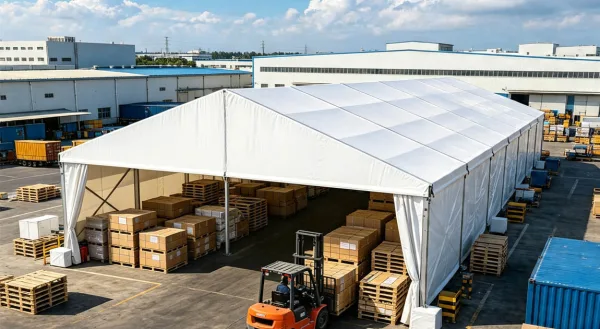
Summer is the most frustrating season for warehouse tent users.
Once the sun hits, the inside temperature easily soars to 40–50°C. Goods that are sensitive to heat and humidity suffer, workers sweat profusely, and productivity plummets. To make matters worse, some warehouses—due to site constraints or special cargo requirements—can’t simply open up the side walls. The result: trapped heat, musty odors, and poor air circulation.
But here’s the good news—the industry has long developed a set of proven, practical, and cost-effective solutions for insulating and ventilating warehouse tents. Today, we’re sharing these tried-and-tested tips so you can find the best fit for your facility.
Solution 1: Roll up the side walls in summer – simplest, cheapest, and fairly effective
If your tent has no nearby obstructions and you’re not overly concerned about privacy or security, opening the side walls in summer is the most economical way to improve ventilation.
Natural cross‑breezes flow through the tent, carrying away heat and moisture—at nearly zero cost. Many temporary storage and short‑term projects lower internal temperatures by 5–8°C using just this method, with a noticeable improvement in comfort.
Best for: Short‑term storage, open sites, general cargo with no strict temperature/humidity requirements.
Note: When side walls are open, watch out for rain and security. Consider roll‑up side wall designs that allow flexible adjustment of the opening height.
Solution 2: Install industrial fans along the side walls – mechanical ventilation with high airflow
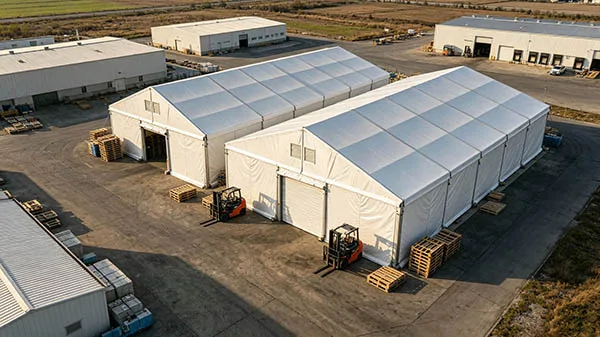
For situations where opening the side walls isn’t practical (e.g., near residential areas where dust could be an issue, storage of goods sensitive to windblown dust, or when some privacy is needed), mechanical ventilation becomes the go‑to approach.
Place industrial fans (axial fans or large floor fans) strategically around the side walls to force air movement. For a large space of several hundred to a thousand square meters, multiple fans working together are often needed to achieve a good air exchange rate.
The advantages: controllable, consistent, and unaffected by outdoor weather. The downsides: some noise, and energy costs rise significantly with larger areas. This is a popular choice for industrial settings and long‑term fixed storage.
Best for: Industrial goods warehouses, sites where side walls can’t be easily opened, scenarios requiring forced airflow.
Note: Distribute fans evenly to avoid “spot ventilation with hot dead zones.”
Solution 3: Add ventilation skylights on the roof – harness natural physics to let hot air escape
This is a clever, low‑effort solution.
Hot air naturally rises—use that principle by installing ventilation skylights (also called passive turbine ventilators) on the tent roof. These devices use wind power or slight indoor‑outdoor temperature differences to continuously exhaust hot, stale air trapped at the roof, while fresh air is drawn in through gaps in the side walls.
No electricity needed (for passive models), no noise, and they effectively reduce the stuffy feeling inside a closed tent while keeping the air fresh. Ideal for goods that emit odors or are sensitive to heat.
Best for: All types of tents, especially those used year‑round for fixed storage.
Note: The number and placement of skylights should be calculated based on tent area and span—consult a professional tent manufacturer for layout advice.
Solution 4: Install PVC screens on the side walls – get airflow even when side walls stay closed
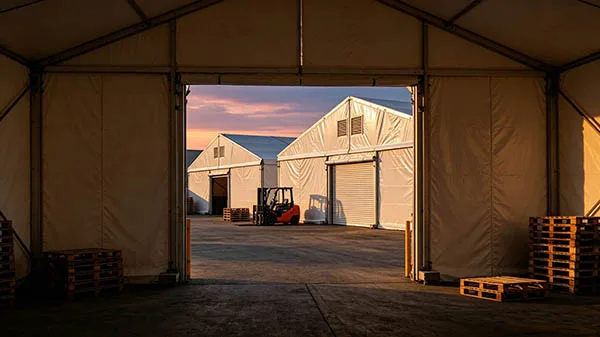
Sometimes side walls can’t be opened—maybe for security, insect control, or because the goods need some shading. But a completely sealed tent becomes unbearably stuffy. What to do?
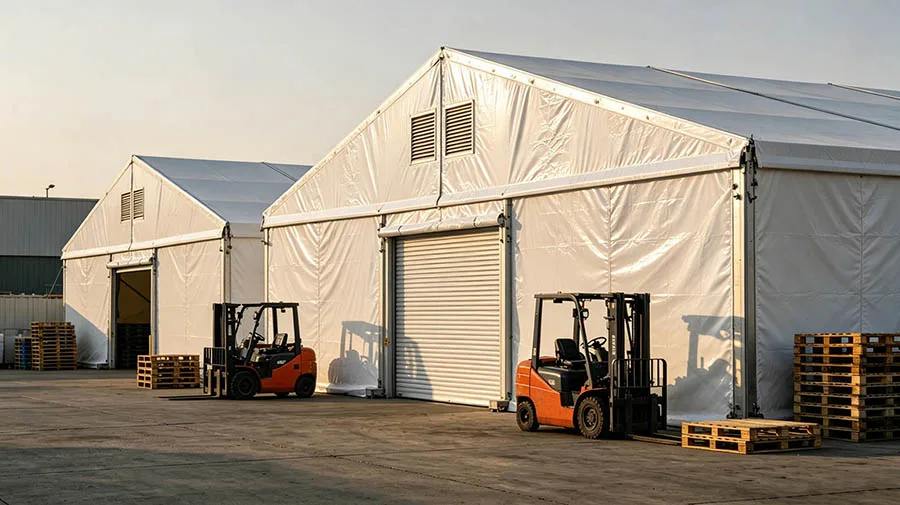
A smart industry trick is to add PVC‑coated screens on the side walls. Normally the side fabric stays down; when ventilation is needed, open only the screened sections. You retain shading and security while increasing airflow.
These screens are durable, waterproof, and resistant to tearing. They can be designed as roll‑up or sliding panels for great flexibility.
Best for: Warehouses that need some privacy or security but still require better airflow.
Note: The screen opening area should be at least 20–30% of the side wall area; otherwise the effect will be minimal.
Solution 5: Insulation + air conditioning – the high‑end approach to true “climate‑controlled storage”
The four solutions above focus on ventilation and cooling. But if your goods have strict temperature/humidity requirements (e.g., food, chemicals, precision instruments), or if you need real cool storage in extremely hot regions, you’ll need active insulation + air conditioning.
This solution has two layers:
1. Side wall insulation: 50cm thick sandwich panels
Standard tarpaulin or single‑skin steel panels offer limited insulation. The real deal is 50cm thick rock wool or polyurethane sandwich panels for the side walls. That thickness far exceeds conventional building insulation, giving a very low thermal conductivity that blocks outdoor heat from entering.
2. Roof insulation: two proven methods
- Method A – Attach insulation cotton inside the roof fabric
Add aluminum‑foil fiberglass insulation cotton to the inner side of the roof tarp. It reflects radiant heat and blocks conducted heat, with relatively simple installation. - Method B – Use the frame depth to create an air cavity
This takes advantage of a unique feature of large‑span tents. For example, on a 40‑meter span tent, the main beam thickness can reach 300–350mm. Using that depth, install two layers of fabric—one on the top of the beam and one on the bottom—creating a stable insulating air cavity between them. Air is a poor conductor of heat, so this cavity dramatically slows heat transfer from the roof into the interior.You can even add small fans to circulate air within the cavity for even better performance. This solution keeps the tent lightweight while achieving insulation performance close to that of a permanent building.
With the above insulation in place, add suitable industrial air conditioners or portable coolers, and you’ll have a truly climate‑controlled warehouse tent.
Best for: High‑value goods, food/medical storage, long‑term fixed use with adequate budget.
Note: Higher upfront investment. Calculate the payback period based on the value of your goods and expected storage years.
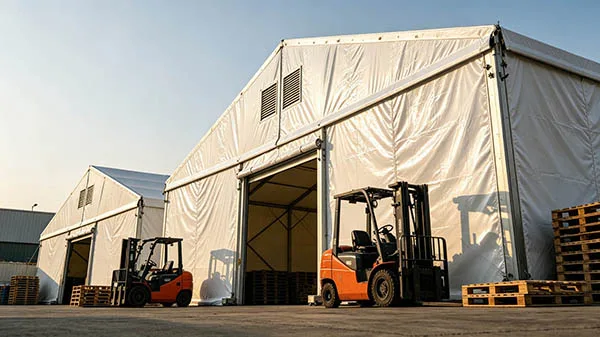
Final thoughts: No one‑size‑fits‑all, just the right combination for you
Ventilation and insulation for warehouse tents is never a “one‑trick” matter. You can mix and match these solutions based on your actual needs:
- General goods, short‑term use: Open side walls + roof skylights – low cost, gets the job done.
- Industrial storage, side walls must stay closed: Industrial fans + PVC screens + skylights – a blend of mechanical and natural ventilation.
- High‑value goods, long‑term climate control: 50cm thick sandwich panel side walls + double‑layer roof cavity + air conditioning – the complete package.
Your warehouse tent deserves a summer that’s not scorching, humid, or risky for your goods. If heat is giving you headaches, run through these five solutions and find the one (or the combination) that works best for you. Start your upgrade today!
 EN
 ZH