


Table of Contents
When a friend asked me, “Have you built your gym yet?” I answered, “Yes, but not the kind you think.”
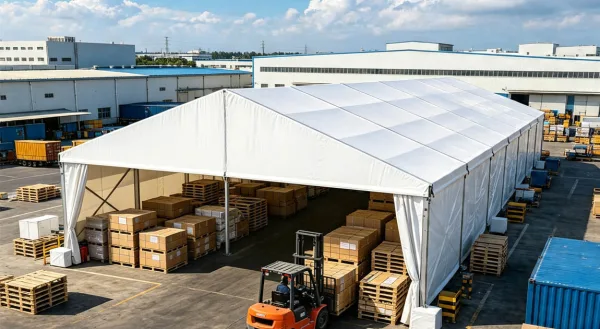
Seven months ago, I was tearing my hair out over the budget for a school sports facility. Traditional steel‑and‑concrete structures cost two or three million dollars, and from project approval to delivery could take a year or more. Just the permitting process alone was enough to make anyone doubt their sanity. In the end, I took a path that seemed “non‑mainstream” – an aluminum prefabricated tent for sporting events. That decision gave me a 3,000 m² professional sports space in just seven days.
If you’re also struggling with the question “How should I build my gym?”, I hope my experience and reflections can give you some inspiration.
1. The Truth About Cost: Money Saved Goes Where It Matters Most
The most direct reason I chose a tent was cost.
Let’s start with real market prices (per m²):
- Aluminum‑frame tents for sporting events: $49–83
- Simple steel structure buildings: $42–56
- High‑spec traditional gyms (steel/concrete or grid structures): $347–556
At first glance, the price gap between aluminum tents and simple steel structures isn’t huge – steel is even slightly cheaper. So why didn’t I go with the cheaper steel option?
The key difference: Steel structures are “semi‑permanent” – they still require foundations, full permitting, interior and exterior finishing, and construction takes time with hidden costs. In contrast, aluminum tents are true prefabricated temporary buildings. They need almost no foundation (in most cases, just a hardened ground surface or screw piles), follow a temporary‑building approval path, and are measured in days.
Tents vs. traditional gyms: the cost is only one‑fifth to one‑fourth – that’s the real value for money.
But be careful: don’t let “cheap” be your only reason. What really convinced me was cost structure optimization – freeing money from “steel and concrete” and putting it into sports flooring, professional lighting, HVAC systems, and venue operations. Traditional construction concentrates costs on civil works – you spend hundreds of thousands or even millions and get four walls and a roof. The money saved with a tent can be used to buy imported sports flooring, install LED energy‑efficient lighting (60% lower daily electricity consumption than traditional lights, saving over 12,000 kWh per year), and equip intelligent temperature control. The former is “dead assets”; the latter is “living facilities” – that’s the essence of cost‑effectiveness.
An often overlooked comparison: simple steel vs. aluminum tents
Although simple steel has a lower unit price ($42–56/m²), it has three hidden drawbacks:
- Heavier self‑weight – higher demands on foundation bearing capacity; soft soil requires extra treatment, adding cost.
- Difficult to dismantle and relocate – once built, it’s almost immobile; zero flexibility.
- Appearance and interior experience – simple steel often looks crude, while aluminum tents can look modern and attractive with fabric colors, glass walls, and interior design.
So my logic was: if you want the lowest price and permanent fixation, simple steel might work. But if you want flexibility, speed, professional experience, and movable assets, aluminum tents are the better choice.
2. The Value of Time: While Others Are Still Waiting for Permits, I’m Already Open
The construction schedule of a traditional gym is a black hole – land planning, construction drawings, bidding, main structure, interior finishing – months at best, years at worst. I saw a school take a year and a half just to get a building permit, then another year to finish the gym.
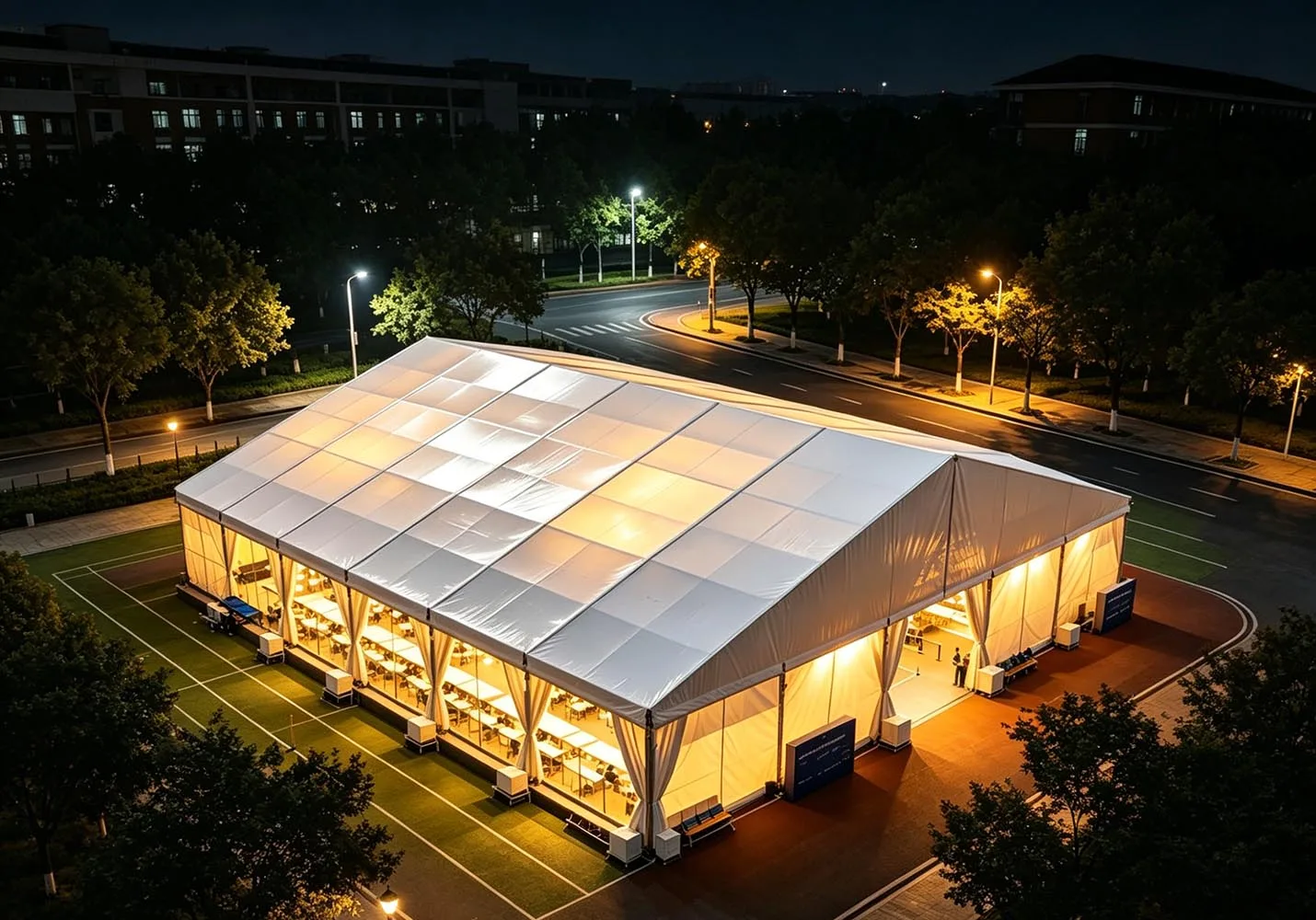
The speed of a tent gym amazed me: factory prefabrication, on‑site assembly. A thousand‑square‑meter venue takes just days to complete. I chose Anteng Tent to build a 3,000 m² facility – from project start to official opening took only 7 days, and it can accommodate 800 students for sports activities. This “build‑and‑use‑immediately” model turns what used to be a long wait into a plug‑and‑play rapid deployment.
This isn’t about saving time – it’s about capturing the market. The sooner you open, the sooner you generate revenue and serve users.
3. Compliance Is Not a Barrier: The Permitting Path Is Clearer Than You Think
This was my most surprising discovery, and where many peers misunderstand.
Before I started, like most people I worried that a tent gym would get stuck in permitting and fire codes – the words “temporary building” really make you nervous. But after research, I found that governments are actively streamlining the process. For example, Hohhot city issued a “Construction Planning Permit Exemption List”, clearly stating that some temporary buildings do not need a planning permit. Xiangyang released its second exemption list, covering 28 types of construction projects that need no permit or are exempt.
For fire safety approval, the path is equally clear. According to the “Interim Regulations on Fire Safety Design Review and Acceptance of Construction Projects”, sports venues with a total floor area no greater than 500 m² can follow a simplified notification‑commitment process. Projects over 500 m² require a special fire safety design review – plan ahead.
Prefabricated tent basketball courts fall under temporary building regulations – just apply for a temporary building permit, a relatively simple process that allows rapid opening. For anyone who wants to get a project off the ground quickly, this is a major advantage.
4. Land and Environmental Protection: Why Choosing a Tent Gives You Policy Support
Another advantage of tent gyms is their adaptability to land. Tents are temporary prefabricated structures with low site requirements – they can be placed on unused urban spaces: public plazas, vacant community lots, school playgrounds. The policy direction of “revitalizing idle urban land” effectively promotes the use of existing land resources.
I visited a successful case: a city used a long‑idle urban green space to build a multi‑sports venue, raising land utilization from 0 to 100%, greatly improving nearby residents’ fitness conditions. This “needle‑threading” urban renewal model won support from both the community and the government.
More importantly, tent gyms align with the policy push for prefabricated and green‑low‑carbon construction. Many local governments have explicitly required that government‑invested or government‑led public buildings – including sports facilities – adopt prefabricated construction to reduce energy consumption and carbon emissions during construction. The main frames of tents use recyclable materials, cutting carbon emissions by 90% compared to traditional buildings, in line with green building concepts.
In addition, factory processing and on‑site assembly produce no construction waste, no wet work, and no on‑site fabrication – the process is clean and pollution‑free. As policies increasingly favor prefabricated and green buildings, choosing tents is actually going with the flow.
5. Technology and Operations: Professional Performance Is More Than Enough for Sports and Education Integration
Many people question the professionalism of tent gyms – can you play basketball? Host competitions? Won’t it be freezing in winter and boiling in summer?
The answer: no problem at all.
Insulation and temperature control – modern tent technology is very mature. A gym tent uses a high‑strength aluminum frame and PVC‑coated fabric, with a cotton‑filled roof layer for insulation, significantly reducing air‑conditioning load. The curved design looks modern and generous, with an eave height of 7.5 m.
Structural safety – aluminum tent structures can withstand wind loads of 8‑10 on the Beaufort scale and snow loads of 0.15‑0.3 kN/m² (roughly 15‑30 cm of snow). Fire resistance meets Class B1 (flame‑retardant) under national standard GB8624. However, the industry lacks a unified national standard – when purchasing, make sure the supplier provides clear profile specifications (6061‑T6 aluminum recommended), connection standards, and third‑party safety certification.
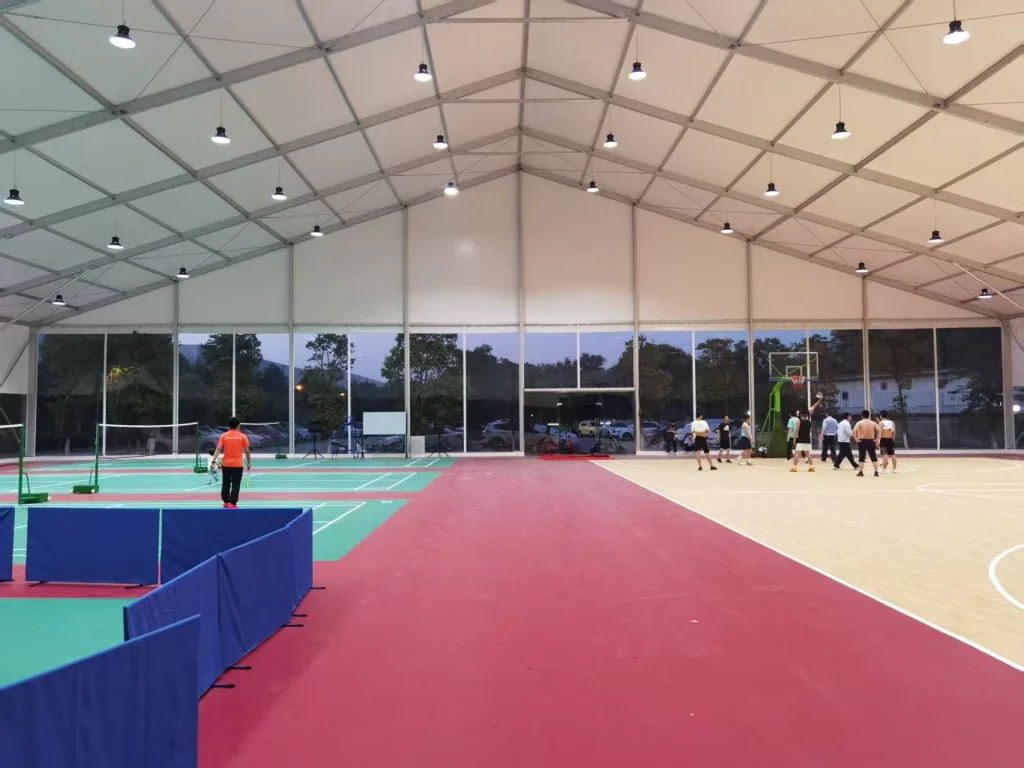
Acoustic and lighting environment – equipped with professional lighting systems; LED energy‑efficient lights use 60% less electricity daily than traditional lights. Perimeter walls can be high‑strength aluminum glass walls or double‑coated fabric, balancing daylight and insulation. Reverberation is controlled by hanging sound‑absorbing spheres (NRC ≥ 0.9), with 6‑8 spheres per 100 m², shortening reverberation time by 0.3‑0.5 seconds.
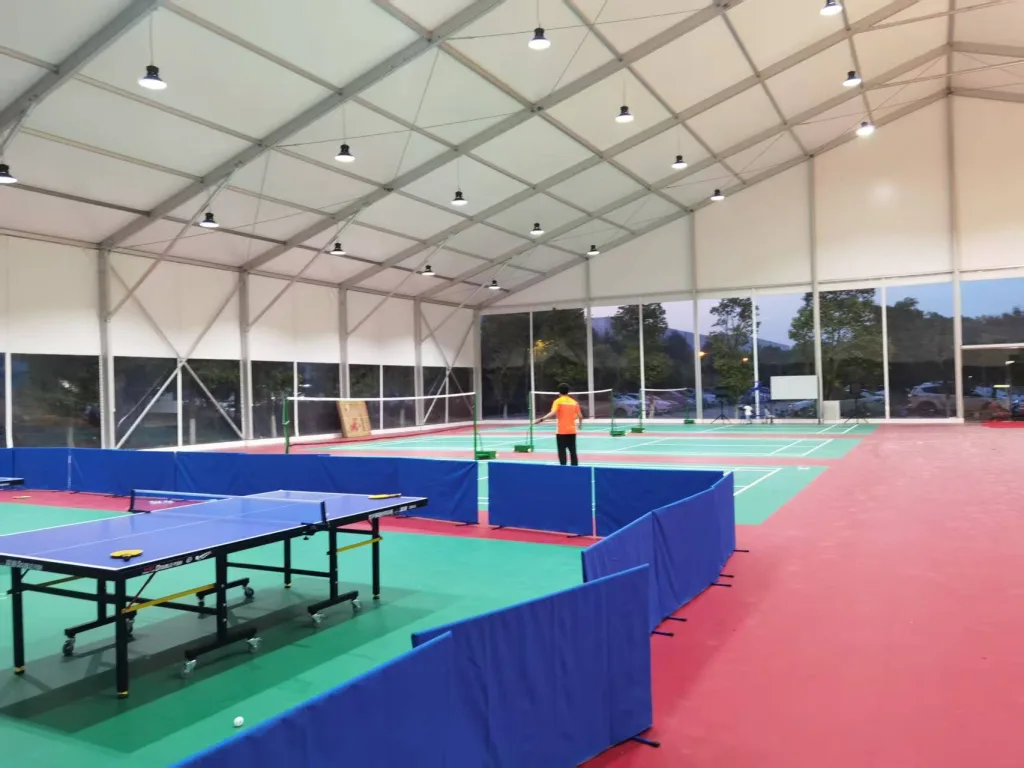
Sports experience – you can lay professional sports vinyl flooring; the shock absorption, slip resistance, and bounce feel are no different from a traditional indoor court. It can even meet FIBA standards (clear height ≥ 7 m, court size 28 m × 15 m).
6. Flexibility and Sustainability: A Venue That Can “Grow” with You
I had a very personal reason for choosing a tent: “changeability.”
Once a traditional gym is built, it permanently occupies that land and is hard to adjust. A tent gym’s size is flexible – length can be extended infinitely by adding 3 m or 5 m modules. If student numbers increase or your business expands, you can add more sections to the existing tent without finding a new site. If a school or community needs to relocate due to development plans, the tent can be quickly disassembled and rebuilt at a new location, maximizing asset utilization. The aluminum frame can be dismantled and reassembled over 200 times under normal outdoor conditions.
My thinking is simple: instead of sinking all your money into a “fixed” space, use a “growable” solution that evolves with your needs.
7. My Operating Model: From a Sports Venue to a Multi‑Revenue Hub
Building the venue is only the first step. The key is how to make it “alive.” Here’s my operating plan:
- Daytime (8:00‑17:00): School sports classes and youth training – partner with nearby schools to provide professional court services.
- Evenings (18:00‑22:00): Open to community residents with a membership + pay‑per‑visit model; host community basketball leagues, badminton matches, etc.
- Weekends & holidays: Sports tournaments, corporate team‑building events, sports goods exhibitions. Industry data shows a 1,500 m² tent venue can average 300 daily visitors, achieving efficient profitability through time‑slot rentals and training courses.
I should note that I chose a purely commercial operation, so I haven’t faced the problem of “promising free access but failing to deliver.” If you’re doing a public‑interest project, I suggest clarifying the operating policy and fee structure at the very beginning to avoid disputes later.
8. Two Decision Traps and One Ultimate Consideration
From my own experience, there are two “invisible traps” to watch out for:
Trap #1: Assuming “tent = cheap.” If your land requires complex foundation work (e.g., soft soil) or you need high‑spec insulation and air conditioning, the total cost may approach that of a simple steel building. Always ask the supplier for an itemized quotation – foundation, frame, insulation, HVAC, lighting, flooring – don’t just look at the “price per square meter.”
Trap #2: Ignoring relocation costs. Although tents are “movable,” each dismantling and reassembly involves labor, transport, and re‑commissioning costs. If you don’t move often, this advantage may not be significant.
What really made me decide was an ultimate consideration: from “building a venue” to “building an ecosystem.” Tents use a fully bolted connection structure, with a dismantling and recycling rate of over 95% , and the main frame has a service life of 20‑30 years. When an industry starts shifting from “one‑time investment” to “life‑cycle management,” choosing a recyclable, movable, growable solution is not only more economical but also more responsible.
If you ask me why I finally chose a tent for sporting events?
The answer is simple: I didn’t buy a building; I bought a solution.
Under the four constraints of capital, land, time, and environmental protection, I needed a solution that is fast to deploy, flexible to operate, safe, reliable, and sustainable. Tents for sporting events meet all of those requirements.
What’s traditional isn’t necessarily right; what’s new isn’t necessarily unreliable. In this rapidly changing era, embracing innovation, flexibility, and sustainability may be the wiser choice.
Finally, my advice: turn the above analysis into a “project feasibility checklist” – check each item: cost, permits, safety, operations, etc. Only when you have all the data clearly in hand can you make the best decision for yourself.
 EN
 ZH